
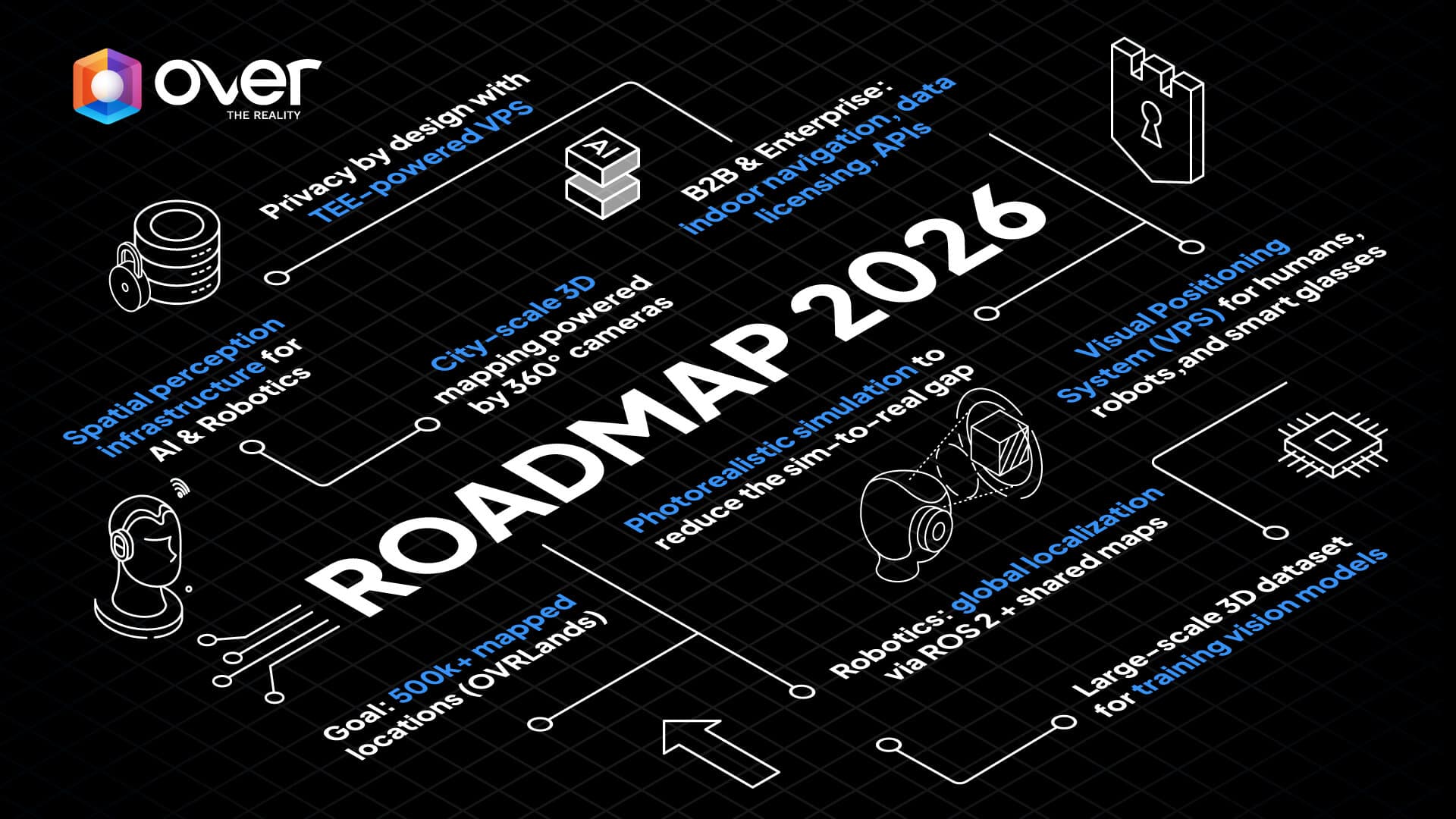
OVER Roadmap 2026
2026-01-27
Reflecting on 2025: From XR Infrastructure to the Foundation of Physical AI
Looking back at 2025, one thing is clear: this was not a year of flashy launches, but a year of deep construction.
We spent the year consolidating our leadership in large-scale 3D mapping, while gradually realizing that what we were building extended far beyond XR. What started as infrastructure for spatial computing has grown into something much more fundamental: a machine-readable representation of the real world.
That realization shaped everything we did in 2025 and it defines where we are going next.
Building the World, One Map at a Time
Over the past year, OVER crossed an important threshold. We reached 180,000 3D maps, built from more than 88 million images, generating a dataset that now exceeds 800 terabytes. Two years ago, this scale felt aspirational. Five years ago, it was simply not feasible algorithms, compute, and coordination were not mature enough.
Yet here we are.
To support the broader AI research community, we open-sourced 1,000 3D maps on Hugging Face, offering real-world, multi-view data to researchers working on vision foundation models. At the same time, we introduced the alpha version of 360 Cam Mapping, opening the door to city-scale reconstruction, and significantly improved both speed and quality in our Gaussian Splat pipeline.
This wasn’t just about collecting more data. It was about proving that large-scale, high-quality 3D mapping of the real world is now possible and scalable.
XR: Removing Friction from Spatial Publishing
On the XR side, 2025 was about reducing friction.
We released the alpha version of our in-app XR Publisher, allowing creators to publish AR content directly from their smartphones. We introduced Image Targets for reliable anchoring, launched an AI-powered 3D asset generator, and streamlined the OVER App interface to make spatial publishing faster and more intuitive.
The goal was simple: make XR publishing feel natural, immediate, and accessible closer to posting content online than deploying complex spatial infrastructure.
Entering Robotics
During the year, something else became clear. The Visual Positioning System we had built for XR was just as valuable for machines.
In 2025, we officially entered the robotics space by extending our VPS to robots, releasing a ROS 2 integration package that enables a wide range of robotic platforms to localize themselves using OVER’s 3D maps. For the first time, robots could share a persistent spatial understanding of the world not just among themselves, but with humans and digital systems.
This was an early step, but an important one.
Privacy as a First Principle
As visual systems scale across phones, smart glasses, and robots privacy becomes existential.
That’s why, in 2025, we filed a patent for a TEE-powered Visual Positioning System, enabling camera pose estimation in encrypted form. The idea is simple but powerful: even the infrastructure provider should not be able to access raw visual data.
This establishes a new privacy standard for XR and Robotics, one that does not rely on trust, but on cryptography and hardware guarantees.
From Platform to Business
2025 was also the year we expanded our business model beyond crypto-native users.
We launched OVER Business, a portal designed to abstract blockchain complexity and allow traditional enterprises to interact seamlessly with the OVER ecosystem. In parallel, we began licensing 3D map data to leading AI labs and deploying large-scale indoor navigation solutions for malls, hospitals, and airports.
To support this growth, we expanded the OVER token economy to Base and Peaq, and closed our first VC round with leading DePIN investors: EV3, Modular, Lattice, and Moonrock.
Looking Ahead: 2026 and the Leap to City-Scale 3D Maps
If 2025 proved that large-scale 3D mapping is possible, 2026 is about scale.
Until now, we generated roughly 100,000 3D maps per year. That changes this year.
With our new pipeline based on consumer 360 cameras, we can cover 10 to 20 times more surface area per unit of time compared to smartphone-based mapping. Depending on the environment, this efficiency gain is dramatic.
Keeping the same level of incentives and community effort, simple math suggests we could reach one to two million mapped locations per year. Even accounting for the additional hardware requirement, we are confident in setting a very ambitious but realistic goal: half a million mapped locations by the end of 2026, and one million within the following two years.
But incentives are only part of the story.
Turning Videos into Explorable Memories
Over the last six months, we’ve been quietly building something new: a pipeline that turns 360° videos into large-scale 3D maps.
The results were strong enough to unlock an entirely new acquisition model.
Soon, anyone will be able to upload a 360 video and receive a free, explorable Gaussian Splat reconstruction. In exchange, OVER receives a free license to the raw data. A simple, transparent trade: data for compute.
This non-incentivized pipeline dramatically lowers acquisition costs and pushes us toward mapping millions of locations per year.
At the same time, we’re introducing OVER Panorama Navigation a 360° scene-graph experience built on top of raw imagery. While Gaussian Splats continue to improve, raw 360 data still offers unmatched visual fidelity at large scales. By combining both, OVER 3D Maps become useful not only for XR, but also for space showcasing, navigation, and enterprise use cases.
Why 3D Maps Are the Real Moat
All of this leads to a fundamental question: why are 3D maps so important?
Because they are the foundation of Physical AI.
In a world of abundant intelligence where software can be replicated instantly the real scarcity lies in high-quality, real-world visual data. You cannot prompt an AI to hallucinate the geometry of a real place. Someone has to capture it. At scale. With precision.
3D maps enable XR anchoring, robotic perception, and the training of machine vision systems. More importantly, they are extremely hard to replicate.
This is the real moat.
OVRLand and Spatial Value
OVRLands are spatial domains the real-world equivalent of web domains. But unlike the web, value here does not come from naming or tiling space. It comes from data.
Software can be copied.
Data of the physical world cannot.
The platforms that will ultimately capture value in spatial computing are the ones capable of generating, maintaining, and serving accurate 3D representations of reality at scale. That is what we are building.
XR, Reimagined for Scale
In 2026, we complete the XR publishing pipeline.
The in-app XR Publisher moves from alpha to full production, joined by the Unity SDK and the Web Builder. Together, they make OVER one of the most complete XR publishing platforms available.
A key unlock is Light Mapping: a lightweight, on-the-fly 3D mapping process that anchors content precisely while publishing. If a full 3D map exists, it’s merged automatically. If not, content is still anchored accurately on site.
City-scale 3D maps generated with 360 cameras will enable remote XR publishing at unprecedented scale.
And as smart glasses move closer to mass-market adoption between 2026 and 2027, OVER will be ready already integrated with early SDKs and backed by a global spatial infrastructure.
AI, Robotics, and the Missing Data Problem
In 2025, we fully embraced a realization: the data we collect is exactly what AI and robotics are missing.
Large Language Models were made possible by the vast textual output of the web. Robotics has no equivalent dataset for understanding the physical world.
That gap is what OVER fills.
Our multi-view imagery and 3D maps are the raw material needed by Vision Foundation Models and World Models alike. Already, our dataset is orders of magnitude larger than those currently used in research.
In 2025, we open-sourced part of it, published a technical paper, and began working with leading AI labs. In 2026, these collaborations turn into production use powering new models, generating new revenue, and reinforcing a self-sustaining flywheel for Map2Earn and the OVR ecosystem.
OVER Robotics: A Shared Spatial Reality for Machines
With OVER Robotics, we take the next step.
Rather than relying on fragmented SLAM systems and siloed maps, robots will localize themselves within a shared, global 3D reference. Through native ROS 2 integration and a dedicated SDK, robots from different manufacturers will be able to perceive, navigate, and interact with the same spatial reality.
At the same time, our photogrammetry and Gaussian Splats will power photorealistic simulation environments, reducing the sim-to-real gap and accelerating robotic development safely and efficiently.
Privacy by Design, at Planetary Scale
Finally, privacy.
As robots and smart glasses scale, naive decentralization is not enough. More servers simply mean more potential attackers.
Our TEE-powered Private VPS, patented in 2025 and deployed in 2026, ensures that visual data is processed in encrypted form even infrastructure operators cannot access it. This is the foundation for a truly decentralized, privacy-preserving VPS network capable of serving millions of locations globally.
Building a Sustainable Business
OVER Business, launched in 2025, will continue to grow as a stable revenue layer decoupled from crypto market cycles.
In 2026, we focus on standardized enterprise offerings:
- Indoor navigation at scale
- Spatial data licensing for AI labs
- Enterprise-grade VPS APIs
This diversification strengthens the long-term sustainability of the ecosystem and the OVR token.
OVER is no longer just mapping places.
We are building the spatial memory that machines and humans will rely on to navigate the real world.
A planetary-scale 3D map.
Readable by machines.
Navigable by humans.
Secure by design.